
August is National Wellness Month — a month dedicated to building healthy habits, emotional balance, and mental clarity. For service members and military families living with ADHD, that framing can feel like a setup. Here’s a different way in.

The Problem With “Just Build a Routine”
Every August, the wellness content rolls in: drink more water, sleep eight hours, meditate, meal prep on Sundays, journal before bed.
If you have ADHD, you have probably tried all of it. Possibly several times. Possibly with a color-coded system you built with real enthusiasm at 11 p.m. on a Tuesday and abandoned by Friday.
The advice isn’t wrong. It’s just written for a brain that runs on a different operating system — one where intention reliably converts into action, where consistency is a matter of discipline rather than a matter of neurology, and where the environment holds still long enough for a habit to take root.
Military life doesn’t hold still. PCS orders, deployment cycles, field time, shift rotations, a spouse’s schedule that changes with the mission. Add ADHD, and the standard wellness playbook — which assumes a stable environment and a brain that self-regulates on command — starts to look less like guidance and more like a list of ways you’re falling short.
You are not failing at wellness. You have been handed the wrong instructions.
What ADHD Actually Makes Hard
It helps to name the specific mechanics, because “I just need more discipline” is almost never the accurate diagnosis.

Time blindness. ADHD brains tend to operate in two tenses: now and not now. A workout scheduled for Thursday doesn’t feel real on Monday. Preparation for a deployment three months out doesn’t generate urgency until it becomes an emergency.
Interest-based nervous system. Motivation in ADHD is driven less by importance and more by interest, novelty, challenge, and urgency. This is why a service member can hyperfocus flawlessly through a high-stakes training exercise and then be unable to make a dentist appointment for six weeks. It isn’t a character inconsistency. It’s how the dopamine system is wired.
Executive function load. Initiating, sequencing, switching, and stopping tasks all draw from the same limited pool. Military life already taxes that pool heavily — briefings, inspections, gear accountability, family logistics. By the time “self-care” comes up, the tank is empty.
Emotional dysregulation. Often the most underdiscussed piece. ADHD amplifies the intensity and speed of emotional response. Frustration arrives at full volume. Criticism lands hard. In a culture that prizes composure, this can drive a lot of masking — and masking is exhausting.
Rejection sensitivity. A perceived slight from a supervisor or spouse can occupy the entire nervous system for hours. This is not fragility. It’s a well-documented feature of the ADHD experience.
Reframing Wellness for the ADHD Brain
Instead of a habit list, try these four shifts.
1. Build scaffolding, not willpower
Willpower is the least reliable resource an ADHD brain has. External structure is the most reliable.
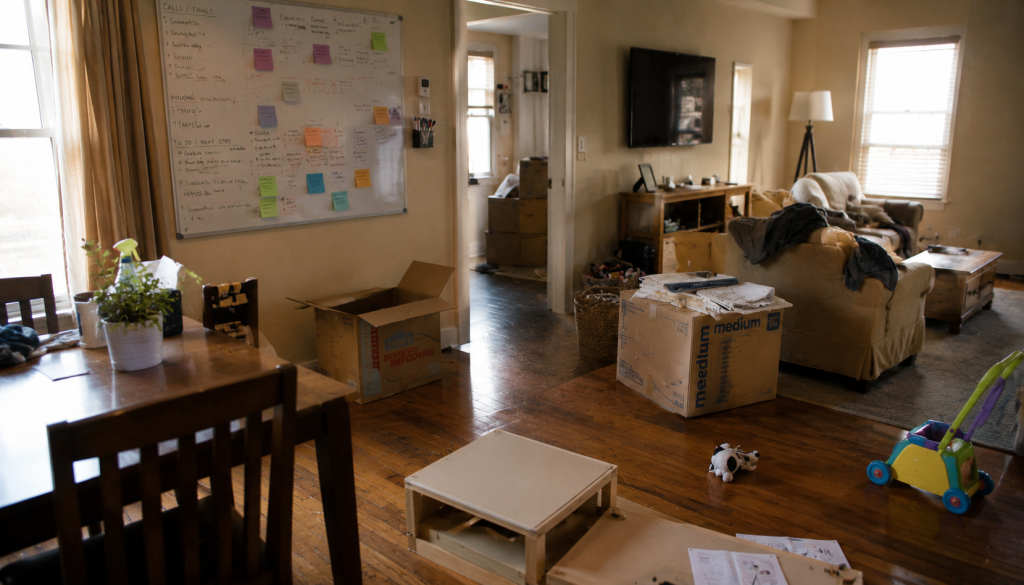
That means: alarms that trigger actions, not just wake-ups. Gear staged by the door the night before. A whiteboard where the plan lives outside your head. And body doubling — doing the task alongside another person — which is powerful enough that it gets its own section below.
The goal is to make the healthy thing the path of least resistance, not the thing you have to summon character to do.
2. Shrink the unit of success
“Exercise four times a week” is a goal that fails on week two and then generates shame that makes week three harder.
“Put my running shoes on” is a goal that works. So is a two-minute walk, a single glass of water, ten minutes of sleep earlier than last night. Completion is the point — finishing something small makes the next attempt easier, and that compounds faster than most people expect. Set the bar where you’ll clear it, then let momentum do the rest.
3. Plan for the disruption, because it’s coming
A wellness plan that only functions in garrison is not a wellness plan. Build a “minimum viable version” of each habit for the weeks when everything falls apart: the field-condition version, the deployment version, the PCS-week version.
If your normal routine is a 45-minute gym session, your minimum version might be ten push-ups and a walk. Deciding this in advance — while your executive function is available — means you don’t have to make the decision in the moment, when it isn’t.
4. Track how you feel, not just what you did
Many ADHD adults have spent years being evaluated on output. Emotional balance requires a different metric.
Once a day, name the feeling and the intensity. That’s it. This builds the interoceptive awareness that most ADHD adults were never taught, and it’s the foundation of regulating emotion rather than being run by it.
Why Exercise Doesn’t Feel Like They Said It Would
One more piece of standard advice worth correcting.
You’ve been promised a rush — the endorphin high, the euphoria that supposedly keeps people coming back. If you’ve done the workout and mostly just felt tired, you may have decided something is wrong with your effort.
The endorphin story is outdated even for neurotypical people; when researchers blocked opioid signaling, the good feeling showed up anyway. And there’s early evidence the exercise-driven dopamine and norepinephrine surge may be blunted in ADHD — one small study found a significantly weaker response in ADHD participants doing identical work.
Small study, so don’t oversell it. But the takeaway stands: stop chasing the high. For an ADHD brain the real payoff is quieter and more useful — a few hours of sharper focus and less internal static. Exercise works less like a mood reward and more like a temporary upgrade to executive function.
Which means the smart move is timing. Put it before the thing you’ve been avoiding.
Don’t Do This Alone: Bringing Your Family Into It
Here’s the piece most ADHD advice misses entirely.

Everything above is framed as something you do by yourself, in whatever margins military life leaves you. But the single most reliable ADHD support strategy isn’t an app or a planner — it’s another person in the room.
Body doubling, explained
Body doubling means doing a task in the presence of another person. They don’t help. They don’t supervise. They don’t even have to be doing the same thing. They’re just there.
It sounds too simple to work, and it works anyway. The presence of another person supplies the external accountability and mild social activation that an ADHD brain can’t reliably generate on its own. The task that has been sitting untouched for three weeks becomes doable in twenty minutes because someone is sitting at the other end of the table paying bills.
You almost certainly already have body doubles living in your house.
What this looks like in a military household
With your spouse. Fifteen minutes, side by side, each doing your own dreaded task. They handle the school forms; you handle the reimbursement paperwork you’ve been avoiding since the last move. No one is helping anyone. You’re just not alone with it.
Take a walk together after dinner instead of scheduling separate workouts neither of you does. Do a Sunday “what’s coming” conversation — not a lecture about what you forgot, just a shared look at the week.
With your kids. Ten minutes of “everybody resets their space,” timer running, music on. Or a family walk where the point is the walk, not the fitness outcome. Kids are excellent body doubles because they have no agenda about your productivity — and if one of your kids also has ADHD, you have just modeled the strategy instead of lecturing them about it.
Across distance. Body doubling works over video. A spouse on the other end of a deployment, a battle buddy at another duty station, a sibling three time zones away — open the call, say what you’re each going to work on, and work. This is one of the few ADHD strategies that survives geographic separation intact, which makes it unusually well suited to this life.
The part that matters more than the productivity
Military families spend a lot of energy managing absence — the deployment, the field rotation, the long shift, the mental absence of someone who is physically home but somewhere else. ADHD adds another layer, because attention is the currency of connection, and ADHD makes attention unreliable in exactly the moments people notice most.
A lot of ADHD partners carry real guilt about this. A lot of ADHD parents do too.
Something I find myself saying often: set the guilt and shame down — just for a little while — and look for a solution to your actual circumstances. Guilt is not a plan. And when you’re sorting through the problem, remember there are valuable things inside it worth protecting. You are one of them. Your marriage is another.
This matters because guilt tends to make wellness feel selfish, and “selfish” is the fastest way to move something to the bottom of the list. Most people don’t skip caring for themselves because they don’t want to. They skip it because they’ve decided everyone else’s needs are the legitimate ones.
Body doubling quietly addresses that, because shared presence is the intervention. You don’t have to perform focus or manufacture a meaningful conversation. You just have to be in the same space, doing your own thing, on purpose. The wellness habit gets built and the relationship gets fed by the same twenty minutes.
One conversation worth having this month
If your family doesn’t know why the standard advice doesn’t work for you, they may be reading executive dysfunction as indifference. That misreading causes more damage in ADHD households than the symptoms themselves.
Try a version of:
“I’m not ignoring it and I don’t care less than you do. My brain won’t start things without external structure. Would you be willing to just be in the room while I do this?”
That’s not asking to be managed. It’s asking for scaffolding — and it’s usually a relief to hear on the other end, because it replaces a story about not caring with a problem that has a solution.
This Month, Pick One Thing
You don’t need a wellness overhaul. Pick one small piece of scaffolding and put it in place this week. If you can pick one that also puts you in a room with someone you love, better.

One last thing, because it’s the pattern I see most: people rarely get stuck because the strategy was wrong. They get stuck because they never actually made their own wellness a priority — it stayed on the list as something they’d get to once everyone else was handled. That day doesn’t arrive on its own. You are allowed to be one of the people you take care of.
Wellness for an ADHD brain isn’t about becoming a more disciplined person. It’s about building a life that works with the brain you actually have — and you don’t have to build it alone.