I tell my clients to go hug a tree.
I mean it. Not as a metaphor, not as a quirky therapist thing — I mean literally go outside, find a tree, and wrap your arms around it. Feel the bark under your fingertips. Notice whether it smells like rain or pine or warm earth. Just be there for a moment.
People look at me a little sideways when I say it. But they come back the next week and tell me something shifted.
This past Thursday and Friday, I had the privilege of volunteering as a photographer at a therapeutic riding center near me — and I watched that same kind of shift happen over and over again, right before my lens.
The Kids Who Chased Laughter Through the Brush
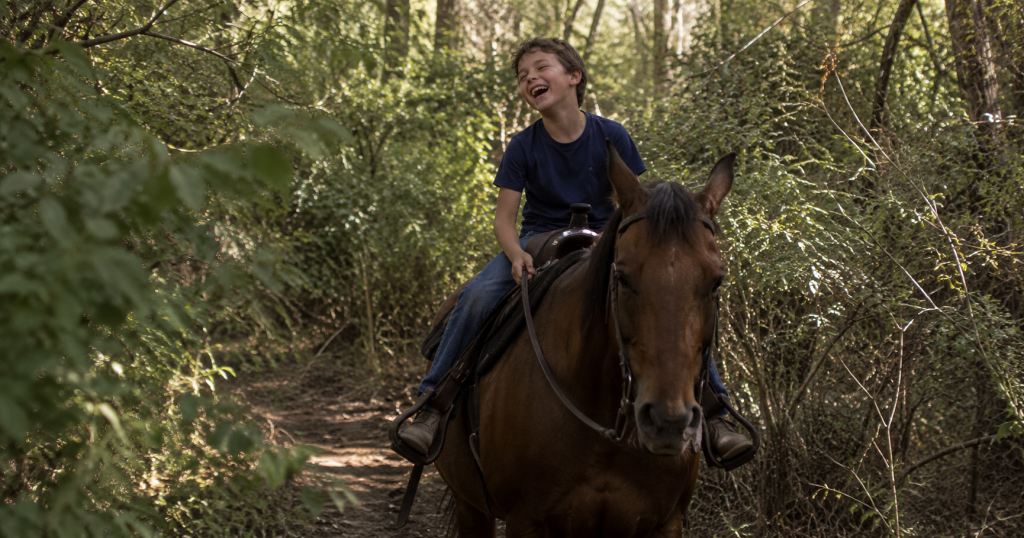
The first group was young people. Their challenge: ride their horses into a dense, bushy area and complete a scavenger hunt for camping supplies. The rider who found the first aid kit earned a special bonus.
The first group was young people. Their challenge: ride their horses into a dense, bushy area and complete a scavenger hunt for camping supplies. The rider who found the first aid kit earned a special bonus.
What followed was gloriously messy. Horses don’t navigate tight quarters on command. Kids called out to each other, got tangled in branches, laughed when things went sideways, groaned when the horse had other ideas. There was real frustration in that thicket — and then real triumph when they pushed through it.
I kept my camera trained on their faces. The smiles when they succeeded were the kind that come from the gut, the kind you can’t manufacture. They hadn’t just found a first aid kit. They had figured something out — about patience, about persistence, about what it feels like to be in partnership with a living creature much bigger than themselves.
That is what curiosity does. It pulls us into the unknown, lets us stumble around for a while, and then hands us something we couldn’t have planned for.
The Woman Who Decided to Be Brave
The next day brought a group of seniors, and with them came three stories I won’t soon forget.
The first was a woman who had never ridden a horse. More than that — she was afraid of horses. She came to this event anyway. That alone takes a particular kind of courage that we don’t always name: the courage to show up somewhere that makes you uncomfortable, just to see what might happen.
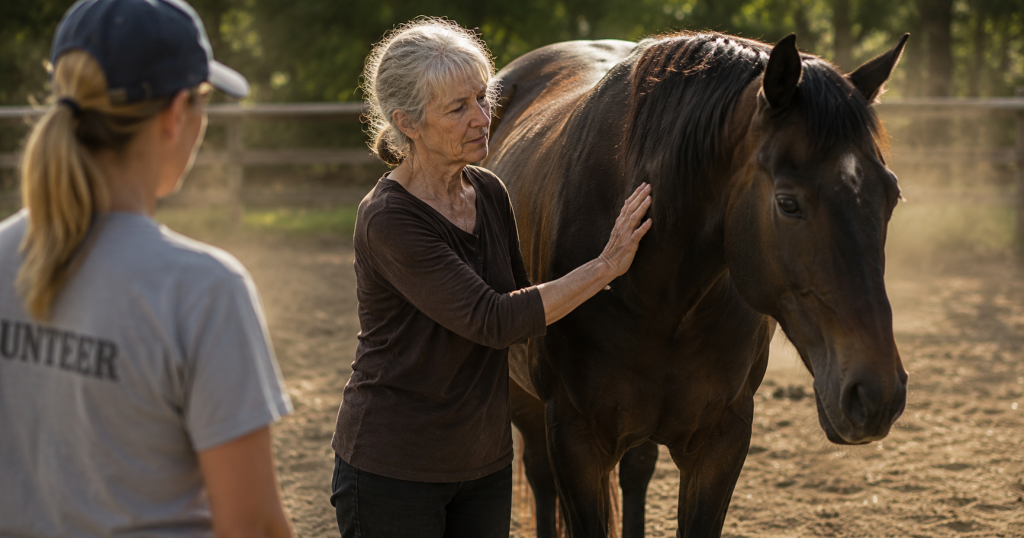
She started small. She decided she would pet the horses. That was her goal for the day.
Then the offer came to ride. She stepped back. She watched. One rider mounted and went around the arena. Then another. Then a third. And somewhere in that waiting and watching, something moved in her.
She approached the horse.
With the help of the volunteers, she got on.
When it was over, she stood beside the horse she had just ridden — this beautiful animal she had once been afraid of — and she could not believe what she had done. I was there. I caught that moment on camera. The expression on her face was not just happiness. It was a woman meeting a new version of herself.
This is what becoming curious about our own fears can do. Not reckless courage, not forcing ourselves through something — but the quiet, watchful kind of curiosity that says I wonder what would happen if I tried. She didn’t have to ride that horse. She chose to. And that choice changed something.
The Woman Who Smiled Ear to Ear
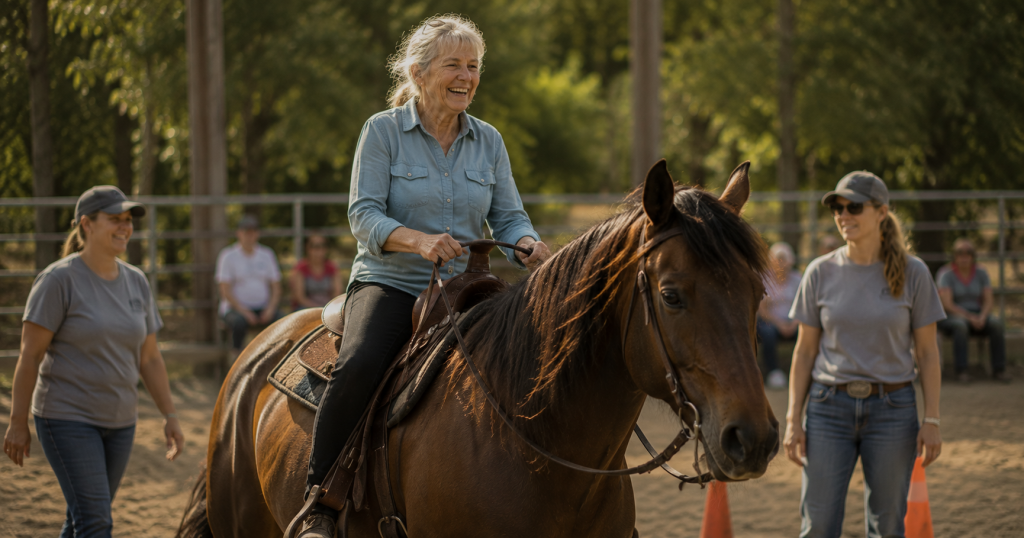
The second story was a woman who had also never ridden a horse. She was the first in her group to volunteer.
She climbed up, and she lit up. Ear to ear — the kind of smile that takes over your whole face. She rode around that arena like it was the most natural, joyful thing in the world.
There is something that happens to us when we step into nature and engage with it fully, when we’re not scrolling or planning or performing — when we’re simply present with a living creature and the ground beneath us and the open air around us. Our nervous systems notice. Research continues to confirm what our bodies have always known: nature is regulating. It lowers cortisol, it quiets the noise, it reminds us that we are part of something much larger and more alive than whatever is sitting in our inbox.
She wasn’t thinking about any of that. She was just smiling.
The Couple Who Held Hands on Horseback
The third story is the one that made me hold my breath behind the camera.
A couple. Married 61 years.
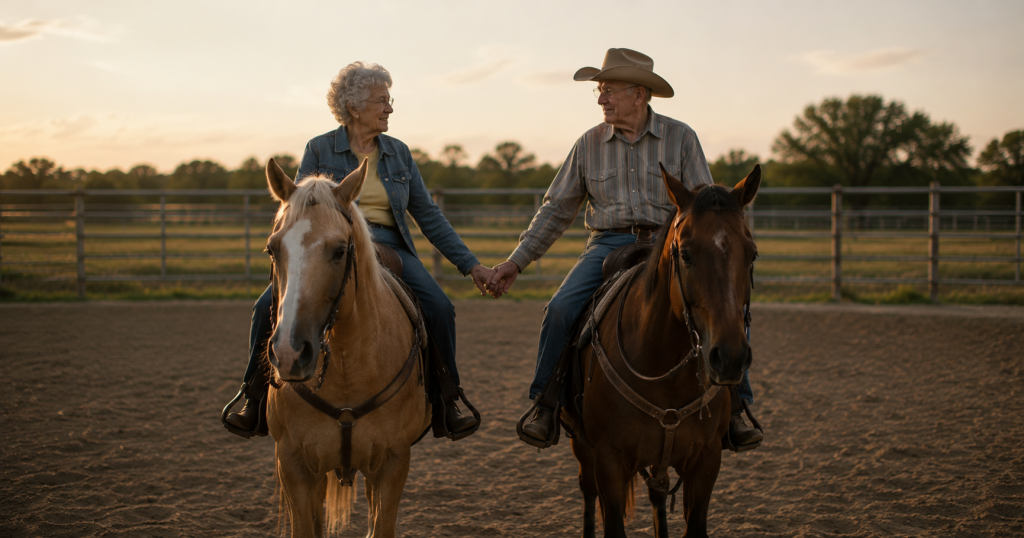
Earlier in their life together, they had shared a love of horses. Time and age had taken that away, the way time and age take many things — quietly, gradually, without ceremony.
That day, they rode together. And when they had finished their ride, they asked me — the photographer — to capture the moment. They sat on their horses side by side, and they reached out and held hands.
I took that picture. And I thought about what 61 years of a shared life looks like when it finds its way back to something it loves.
Getting back to nature isn’t only for the young, or the fearless, or people who already know what they’re doing. It’s for all of us. At every age. After every loss. Through every fear. Nature has a way of meeting us where we are — and so do animals. The horses at that arena weren’t judging anyone’s age or anxiety or inexperience. They were just there, steady and present, offering something that’s increasingly rare: a real, unhurried, living connection.
Why I Keep Sending People Outside
As a therapist, I work with people who are carrying a lot. Anxiety. Grief. Exhaustion. The particular heaviness that comes from spending too much time indoors, in our heads, disconnected from our bodies and the world around us.
The research on nature and mental health is compelling — time in green spaces is associated with reduced symptoms of anxiety and depression, improved mood, better sleep, and restored attention. But I don’t lead with the research when I’m sitting with a client. I lead with a simpler question:
When did you last do something that made you genuinely curious?
Curiosity is underrated as a mental health tool. It’s hard to be curious and catastrophizing at the same time. Curiosity pulls us forward, into the present moment, into engagement. It asks “what if” in an open-handed way, without demanding a particular answer.
And nature — trees, horses, open sky, dirt under your shoes — gives us an endless supply of things to be curious about. It is endlessly, patiently interesting.
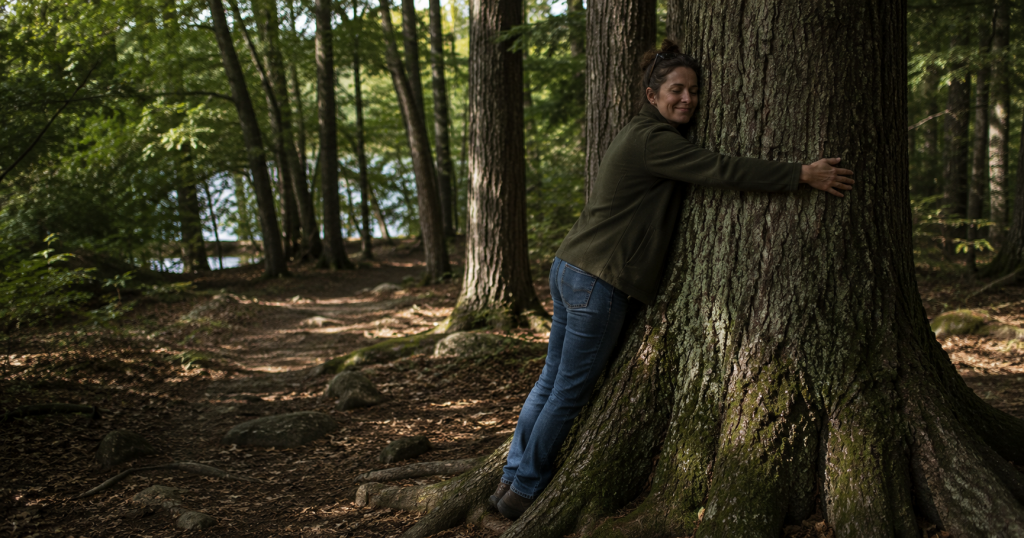
So yes. Go hug a tree. Pet a horse if you get the chance. Let yourself be a little uncertain about what might happen. Watch what it does to you.
I was a photographer at a therapeutic riding center last week, and I watched people face fears, find joy, and hold hands after 61 years of marriage. I watched kids laugh through frustration and come out the other side of it grinning.
None of that happened behind a screen. All of it happened outside, in the presence of beautiful animals, on a perfectly ordinary Thursday and Friday.